



TTMA-200 – Trailer Truck Mounted Attenuator
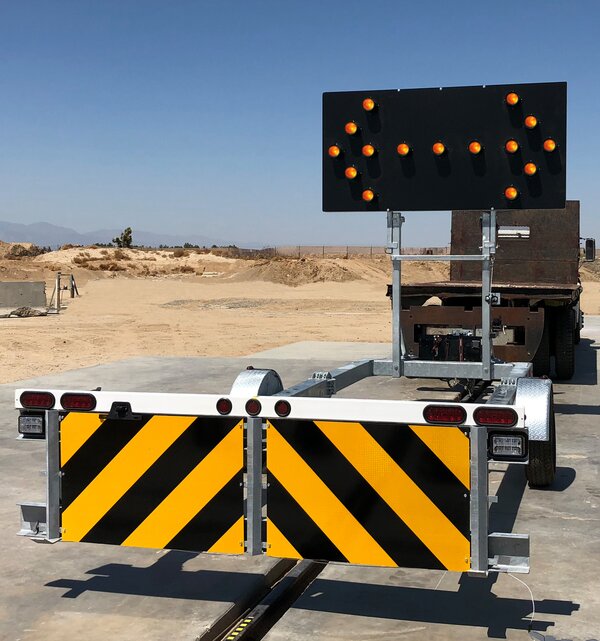
Designed for use in mobile and stationary work zones, Gregory Highway’s TTMA-200 helps to keep your most valuable assets protected in the event of a work zone intrusion. This trailer truck mounted attenuator’s patented, energy-absorbing technology offers flexible performance at a competitive price and meets all required MASH TL-3 testing standards.
What Is a Truck Mounted Attenuator (TMA)?
A truck mounted attenuator (TMA) or trailer truck mounted attenuator (TTMA) is a mobile crash attenuation system attached to the rear of a support vehicle to protect road crews by absorbing impact from errant vehicles in active work zones.
Gregory Highway’s TTMA-200 is made from galvanized steel and built for versatility. The truck mounted attenuator’s single point pintle hitch mount can be used with most supporting vehicles weighing 10,000 lbs. (4,535.9 kg.) or more and can be switched between host vehicles in minutes. Its flexible configuration is easily adaptable to sweeping, salting, mowing and striping operations and can be equipped with optional items, including an arrow board, arrow board stand and hitch extensions. It’s part of our broader selection of impact attenuators for permanent and temporary installations.
When Is a TTMA Required?
A TTMA is required when work zone conditions expose crews to the risk of rear-end collisions.
The TTMA-200 offers mobile crash protection in both mobile and stationary work zones including:
- Highway construction zones
- Lane closures
- Mobile maintenance operations, such as snow removal, sweeping or mowing
- Utility repair work
How the TTMA-200 Works
The TTMA-200 uses a patented system for energy absorption. During a collision, the oversized mandrel pushes into a smaller tube, splitting it into four strips of metal to dissipate the impact energy. The metal strips remain with the trailer and pose no hazard to adjacent traffic.
This cartridge-free design eliminates the need for replacement components, helping crews quickly return the attenuator to service after an impact.
View the TTMA-200 in action:
MASH Compliance & Test Levels
The TTMA-200 was successfully tested and passed all required MASH crash test criteria. The Federal Highway Administration (FHWA) eligibility letter was awarded in March 2019 and is filed as CC-152.
The system meets MASH Test Level 3 (TL-3) requirements, making it suitable for use on higher-speed roadways and typical highway work zones. TTMA-200 attenuators are widely accepted by federal and state DOTs, supporting specification and use across a range of safety applications.
View additional specifications and technical information on our Highway Resources page.
Key Benefits for Contractors & DOTs
The TTMA-200 is designed to improve work zone safety, offering rapid deployment and superior fleet compatibility in a cost-effective, reusable system.
Within minutes, the TTMA-200 can be attached to any support vehicle with a gross vehicle weight (GVW) of 10,000 lbs. (4,535.9 kg) or more. Only a standard eight-ton pintle hitch is needed, and there is no maximum weight limit.
The TTMA-200 offers multiple benefits to contractors and transportation agencies: 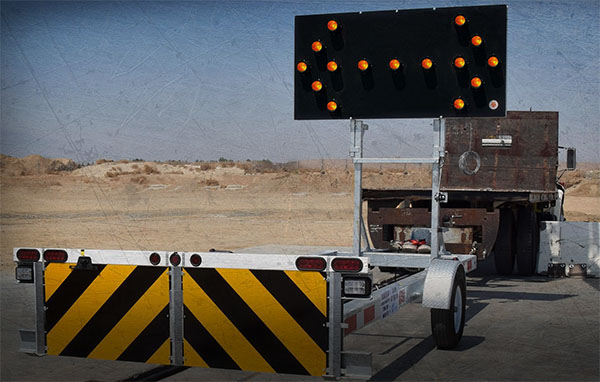
- No host vehicle modifications required
- Open frame system is easy to maintain and repair
- Anti-rotational by design
- No cartridges needed
- Versatile asset protection
Our highway safety products are strong, long-lasting, and easy to install. And when you partner with Gregory Highway —the national leader in highway guardrails and roadside safety—you will always get a quick turnaround and responsive service.
Technical Specifications
- MASH 2016 tested and approved – The TTMA-200 was successfully tested and passed all required MASH crash test criteria. The Federal Highway Administration (FHWA) eligibility letter was awarded in March 2019 and is filed as CC-152.
- Patented energy absorbing technology – During a collision, the oversized mandrel pushes into a smaller tube, splitting it into four strips of metal to dissipate the impact energy. The metal strips remain with the trailer and pose no hazard to adjacent traffic.
- Proven strength and versatility – Within minutes, the TTMA-200 can be attached to any support vehicle with a gross vehicle weight (GVW) of 10,000 lbs. (4,535.9 kg) or more. Only a standard eight-ton pintle hitch is needed, and there is no maximum weight limit.
Product Specifications
- Width: 95 in. (2.4 m.)
- Height: 39 in. (990.6 mm.)
- Length: 23.5 ft. (7.2 m.)
- Approximate weight: 1,450 lbs. (658 kg.)
- Approximate weight with arrow board: 1,750 lbs. (794 kg.)
- Approximate tongue weight: 300 lbs. with arrow board
- Eight-ton pintle hook height: 19.5 to 32 in. (49.53 to 81.28 cm)
- Galvanizing method: Hot dip
- MASH compliance: passed test levels 3-50, 3-51, 3-52 and 3-53
Frequently Asked Questions
What is the purpose of a truck mounted attenuator?
Truck mounted attenuators protect road crews and vehicles from rear-end collisions in active work zones. They absorb energy in a crash, reducing the severity of impact.
Is the TTMA-200 MASH compliant?
Yes. The TTMA-200 is crash-tested and was found to meet MASH testing standards.
What test level is the TTMA-200 rated for?
The TTMA-200 meets MASH Testing Level 3 requirements, making it suitable for use in work zones and on higher speed roadways.
How is a trailer attenuator different from a fixed crash cushion?
A trailer truck mounted attenuator is designed for mobile or temporary protection in work zones and during mobile operations. In contrast, a fixed crash cushion or impact attenuator is installed in a fixed location and is designed to protect a specific hazard, such as a bridge abutment.
Are TMAs required in all work zones?
No. TMAs are specified based on factors including road speed, traffic volume, and worker exposure to live traffic. They’re commonly used in construction zones, mobile operations and lane closures where crews are at risk of rear-end collisions.