



Highway Guardrail and Roadside Safety Barrier Resources
Explore our industry-leading highway solutions
Gregory Highway manufactures industry-leading highway safety products tested to meet AASHTO and MASH standards.
Review our highway resources to learn more about our galvanized highway guardrails, end treatments, high-tension cable barrier systems and other highway safety products.
As a highway guardrail manufacturer, it is our mission to answer your questions, solve your problems and support your business needs any way we can. Contact the Gregory Highway team to learn more.
Gregory Highway Safety Products Catalog
Explore our full capabilities or contact us now to request a quote.
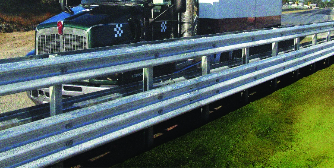
The Guardian 5 (G5) serves as a softer, safer alternative to concrete. It functions as a median and longitudinal barrier that safely redirects a fully loaded 80,000-lb. vehicle. It is utilized in situations that feature reduced post spacing, higher impact speeds and curbing.
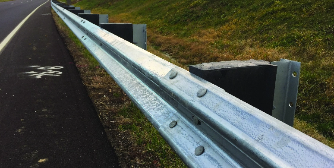
Sell Sheet
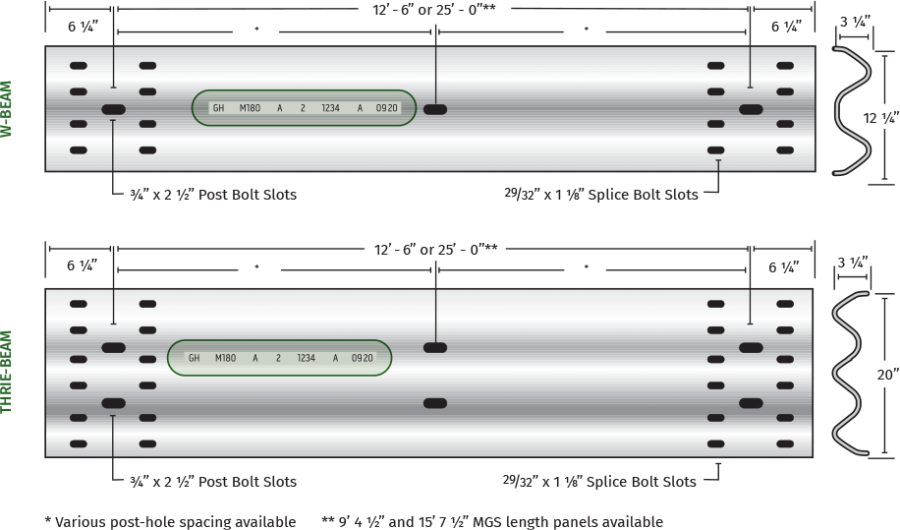
Stamping Codes

- Manufacturer: GH = Gregory Highway
- AASHTO Specifications
- Class: Class A = 12 ga; Class B = 10 ga
- Type:
- Type 1 = Zinc coated 1.8 oz/ft² (550 g/m²) min single spot
- Type 2 = Zinc coated 3.6 oz/ft² (1100 g/m²) min single spot
- Type 3 = Uncoated Steel
- Type 4 = Weathering Steel
- Mill Heat Number
- Operator Identification: A–Z
- Galvanized Lot: 09 = Week (9th week); 17 = Year (2017)
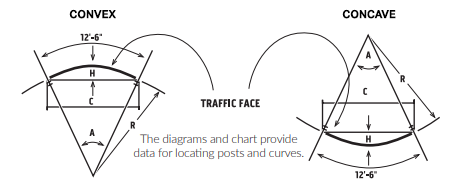
Convex and Concave Curved Guardrail Panels
Guardrail sections to be installed on curves with a radius of 5 ft. to 150 ft. can be curved in our fabricating facilities. Terms convex or concave refer to the inward or outward curve relative to the traffic face of the guardrail.
Finding the radius for a curved guardrail:
Starting at the last post in the straight run (point A), lay cloth tape along the path that the curved guardrail will follow.
Mark off two points along the curved cloth tape: one at 6 ft. 3 in. (point B), and the second at 12 ft. 6 in. (point C).
Pull string directly from starting point (point A) to the second mark-off point (point C).
Measure from the first markoff point (point B) over to the midpoint of the taut string. This measurement (D) is the rise.
Check the chart to find the radius (R), given the rise (D). Example: a rise of 3 7/8 in. would result in a radius of 60 ft.
| RADII | ANGLE | CHORD | HEIGHT / RISE |
|---|---|---|---|
| 5 | 143˚ 14’ | 9' 5-7/8" | 3’ 5” |
| 10 | 71˚ 37’ | 11’ 8-3/8” | 1’ 10-3/4” |
| 15 | 47˚ 45’ | 12’ 1-3/4” | 1’ 3-3/8” |
| 20 | 35˚ 49’ | 12’ 3-5/8” | 11-5/8” |
| 25 | 28˚ 39’ | 12’ 4-1/2” | 9-3/8” |
| 30 | 23˚ 52’ | 12’ 4-7/8” | 7-3/4” |
| 35 | 20˚ 28’ | 12’ 5-1/8” | 6-5/8” |
| 40 | 17˚ 53’ | 12’ 5-3/8” | 5-7/8” |
| 45 | 15˚ 55’ | 12’ 5-1/2” | 5-1/4” |
| 50 | 14˚ 19’ | 12’ 5-5/8” | 4-5/8” |
| 55 | 13˚ 01’ | 12’ 5-5/8” | 4-1/4” |
| 60 | 11˚ 56’ | 12’ 5-3/4” | 3-7/8” |
| 65 | 11˚ 01’ | 12’ 5-3/4” | 3-5/8” |
| 70 | 10˚ 14’ | 12’ 5-3/4” | 3-3/8” |
| 75 | 9˚ 33’ | 12’ 5-3/4” | 3-1/8” |
| 80 | 8˚ 57’ | 12’ 5-7/8” | 3” |
| 85 | 8˚ 26’ | 12’ 5-7/8” | 2-3/4” |
| 90 | 7˚ 58’ | 12’ 5-7/8” | 2-5/8” |
| 95 | 7˚ 32’ | 12’ 5-7/8” | 2-1/2” |
| 100 | 7˚ 10’ | 12’ 5-7/8” | 2-3/8” |
| 110 | 6˚ 31’ | 12’ 5-7/8” | 2-1/8” |
| 120 | 5˚ 58’ | 12’ 6” | 2” |
| 130 | 5˚ 31’ | 12’ 6” | 1-3/4” |
| 140 | 5˚ 07’ | 12’ 6” | 1-5/8” |
| 150 | 4˚ 47’ | 12’ 6” | 1-1/2” |
Hardware Drawings
End Section Drawings
Post Drawings
Transition Drawings
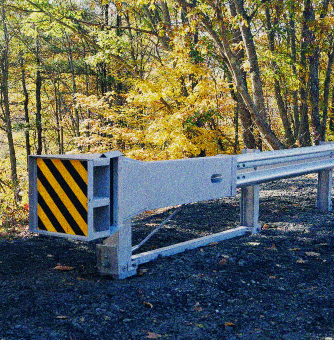
The MFLEAT is a MASH TL-3 compliant, energy-absorbing flared terminal end that safely disperses crash energy during head-on collisions. Functioning like a guardrail, it effectively redirects vehicles to optimize safety.
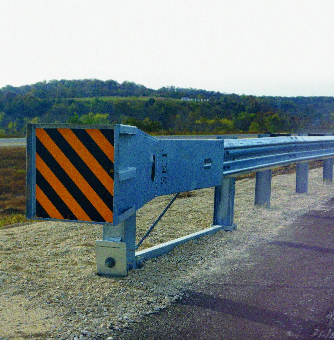
The MSKT is an energy absorbing kinking terminal that functions like a guardrail and safely redirects vehicles. When there is an impact, the MSKT head slides over the W-Beam, kinking the terminal and redirecting vehicles safely.
Sell Sheet
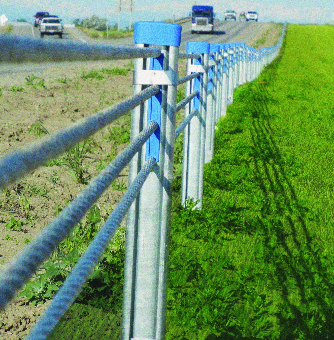
On impact, the cables acquire lateral resistance and are held in place by the end anchors to safely redirect vehicles. Made in the U.S., these cables are used in medians and embankment slopes where forceful collisions are common.
Drawings
Sell Sheet
Acceptance Letters
Reports
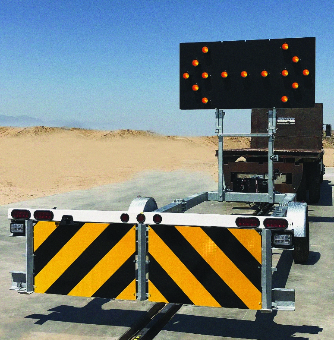
The TTMA-220 is designed for mobile and stationary work zones, protecting valuable assets in the event of a work zone intrusion. It is constructed from galvanized steel and built for versatility.
Sell Sheet
Acceptance Letters
Specifications
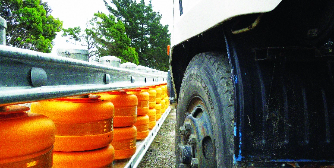
The SB Barrier is designed for roadside or median applications. It converts crash energy into rotational energy when a vehicle comes into contact. It helps to soften vehicle image, redirect vehicles and improves roadside visibility.
Video Resources
MASH MSKT Installation Training 04-28-2017
MASH TL-4 Roller Barrier - Pick Up Test
MSKT MASH SKT Informational Video
Frequently Asked Questions
What is a MASH TL-3 guardrail?
MASH TL-3 guardrail is a highway barrier that conforms to Test Level 3 (TL-3) requirements under the Manual for Assessing Safety Hardware (MASH). These guardrails are designed to safely redirect passenger vehicles traveling at highway speeds. MASH TL-3 compliant systems typically consist of W-Beam or Thrie-Beam guardrail, posts and a MASH-compliant end treatment or terminal (such as MFLEAT or MSKT). Guardian 5 (G5) guardrail is designed to the higher MASH TL-5 requirements, meaning it can safely redirect heavy truck traffic.
What is the difference between W-Beam and Thrie-Beam guardrail?
In highway guardrail systems, W-Beam guardrail has a two-wave side profile — it looks like a ‘W.’ W-Beam guardrail is the most common type of highway guardrail in the U.S. and widely used in MASH TL-3 highway safety systems. Thrie-Beam guardrail is taller and stronger than W-Beam, with a three-wave side profile. It can withstand stronger forces and is often used in higher-risk locations.
What is an energy-absorbing terminal?
An energy-absorbing terminal (EAT) is a guardrail end treatment designed to dissipate crash energy following a head-on impact with the leading end of a guardrail system. As the vehicle strikes the terminal, it extrudes or flattens the W-Beam, absorbing the kinetic energy while decelerating the vehicle as it advances. Energy-absorbing terminals are crash tested to meet federal safety standards including MASH.