


How to Select Roof Blocks for Rooftop Support Systems
Commercial rooftops often carry piping, electrical conduit, cable trays, HVAC and refrigeration lines, solar components and other systems that must be supported above the roof surface.
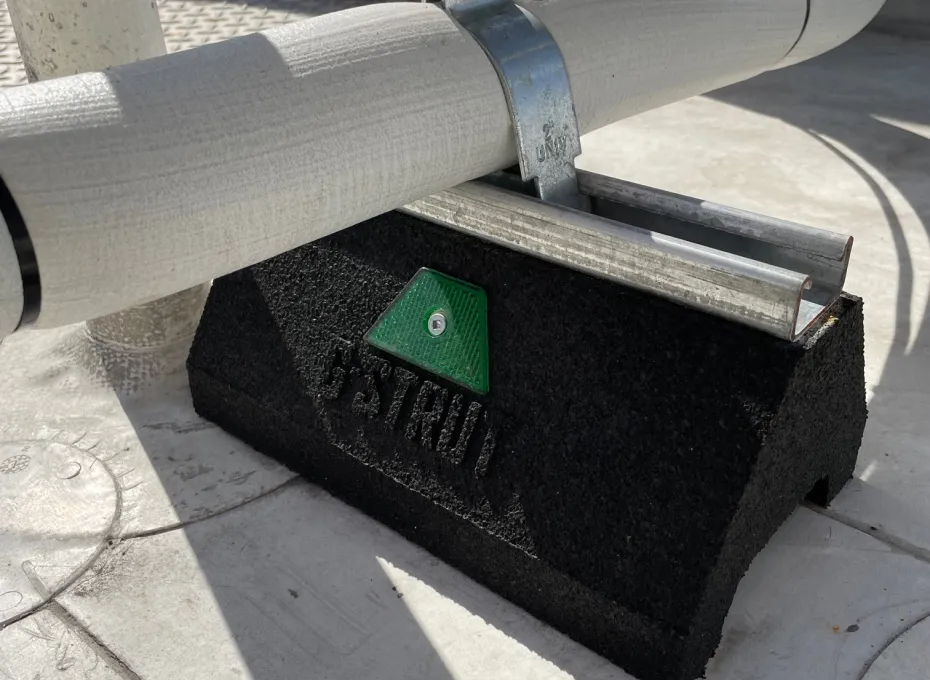
Roof blocks provide a stable base for these systems, while roof blocks with strut create a configurable framework for different layouts and applications. Selecting the right rooftop support blocks requires contractors and engineers to consider the completed load, required elevation, support spacing, potential movement and rooftop environment.
Understanding these factors can help project teams develop a support system that performs as intended and simplifies installation.
What Are Roof Blocks?
Roof blocks are bases used to support piping, conduit, equipment and other systems on commercial and industrial rooftops. Depending on the application, they may be used individually or as part of a larger assembly.
Roof blocks are commonly used for:
- Gas piping
- HVAC and refrigeration lines
- Electrical conduit
- Cable tray systems
- Solar installations
- Mechanical equipment
- Rooftop walkways
- Custom rooftop assemblies
Why Use Roof Blocks With Strut?
Roof blocks with strut provide a mounting surface that allows pipes, conduit and other components to be secured with clamps and fittings rather than simply resting on a base. Contractors can position clamps and supported components along the channel to accommodate different sizes and layouts.
A single roof block with strut may support a compact installation, while multiple blocks connected by a longer channel can support several pipes or a wider rooftop assembly. Channel profiles, riser rods, fittings and accessories can be selected to meet the application’s load, elevation and configuration requirements.
Rooftop Support Block Options
Rooftop support blocks are available in several designs and configurations:
- Standard roof blocks: Full-size or half blocks made from recycled rubber and available without channel or with a short section of strut.
- Multi-base supports: Two or more blocks connected by longer strut channel to support wider assemblies or multiple components.
- Elevated supports: Blocks with riser rods that raise the strut channel when additional clearance is required.
- Roller stand supports: Blocks with rollers that accommodate pipe movement caused by temperature changes.
- Lightweight interlocking blocks: Plastic blocks with lightweight foam bases that can be used individually or connected to create a larger support system.
The appropriate option depends on the system’s space, load, elevation, movement and installation requirements.
How to Select Rooftop Support Blocks
Building the right roof block system requires matching the supported application and rooftop conditions to the appropriate block size, number of bases, channel configuration and support style.
1. Choose the Block Size and Configuration
Begin with the size, weight and arrangement of the supported system. For piping, account for the pipe, insulation, fittings and material flowing through it.
A half block provides a smaller footprint for compact installations, while a full-size block provides a larger bearing surface. A single block with a short section of strut may support one pipe or conduit. Wider or heavier assemblies may require multiple blocks connected by a longer channel to provide additional support points and distribute the load.
Use published engineering data to verify that the selected blocks and channels can support the completed system. The roof structure must also be capable of carrying the imposed load.
2. Determine the Required Support Height
Some rooftop systems require additional clearance to function properly and remain accessible. The required height helps determine whether the application needs a standard block with channel or elevated support.
A standard configuration may be appropriate when the pipe, conduit or assembly can remain close to the roof surface. Riser-rod configurations elevate the channel when additional clearance is needed for pipe insulation, drainage, changes in roof elevation, nearby systems or maintenance access.
As support height increases, stability and loading should be evaluated as part of the complete assembly.
3. Determine Whether the Pipe Must Move
Rooftop piping may expand and contract as operating temperatures and outdoor conditions change. The piping design should establish whether each location requires a fixed, guided or moving support.
When movement must be accommodated, select a roller stand roof block sized for the supported pipe. The roller allows the pipe to move as temperatures change rather than unnecessarily restricting it. Standard block-and-channel configurations may be used where a roller is not required, with the appropriate clamps and fittings selected for the intended support condition.
4. Consider Handling and Installation Requirements
Gregory’s traditional roof blocks are made from recycled rubber to provide a durable base for continuous outdoor use. When lower product weight would simplify storage, transportation and rooftop handling, the G-STRUT® GAB1 Adapt-A-Block may be preferred. It features a lightweight plastic shell with a foam base.
Adapt-A-Blocks can be used individually or interlocked to create a multiple-base support system. Their stackable design also simplifies storage and transportation. The appropriate arrangement should be confirmed based on the application and project requirements.
5. Evaluate the Rooftop Environment
The block, channel and accessories must be suitable for the conditions they will experience. Consider UV exposure, precipitation, freeze-thaw cycles, vibration, corrosive conditions and compatibility with the roofing material.
The strut channel and other metal components should have a material or finish suited to the environment. Review the roofing system requirements and consult the roofing manufacturer when necessary, as some systems may require protective material between the block and roof surface.
Projects subject to high-wind or seismic requirements may need additional restraint, anchorage or bracing beyond a standard rooftop support configuration. Verify these requirements against the approved construction documents and consult the project’s architect or structural engineer of record when necessary.
Once the support arrangement has been identified, use engineering data, product submittals and project documents to confirm block capacity, channel span and support spacing.
Frequently Asked Questions About Roof Blocks
What is the difference between a roof block and a roof block with strut?
A roof block provides the base of the support. A roof block with strut includes a metal framing channel that provides a mounting surface for clamps, fittings and supported components.
How far apart should rooftop pipe support blocks be placed?
Spacing depends on the pipe material, diameter, completed weight, operating conditions and support configuration. Consult the project documents, applicable standards and product engineering information rather than using one spacing rule for every application.
Can roof blocks support more than piping?
Yes. Rooftop support blocks can be configured for electrical conduit, cable trays, HVAC and refrigeration systems, solar installations, walkways and other assemblies.
How do I select strut channel for a roof block?
Consider the total load, channel span, support arrangement and environmental exposure. Compare channel options using published engineering data and verify that the complete assembly meets project requirements.
Explore G-STRUT® Rooftop Support Solutions
Gregory Strut offers roof blocks, strut channel and accessories that can be configured as a complete rooftop support system.
G-STRUT® Rooftop Support Blocks are available in standard, multi-base, elevated, roller and lightweight configurations for piping, conduit, HVAC, solar and other rooftop systems.
Find a Gregory Strut sales representative near you to discuss your roof block needs.